

A Man For All Seasons Film
| A Human being for All Seasons | |
|---|---|
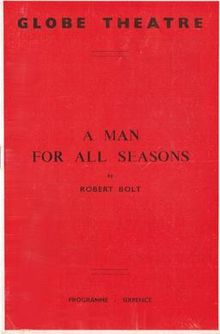 Programme from the original London production (1960) | |
| Written by | Robert Bolt |
| Characters | The Common Man Sir Thomas More The Duke of Norfolk Thomas Cromwell Henry Eight Margaret More William Roper Cardinal Thomas Wolsey Alice More than Thomas Cranmer Richard Rich Signor Chapuys |
| Engagement premiered | 1 July 1960 (London) |
| Place premiered | World Theatre |
| Original language | English |
| Setting | Sixteenth century England |
A Man for All Seasons is a play by Robert Commodities based on the life of Sir Thomas More. An early class of the play had been written for BBC Radio in 1954, and a one-60 minutes live boob tube version starring Bernard Hepton was produced in 1957 by the BBC,[1] but after Bolt's success with The Flowering Cherry, he reworked it for the stage.
It was showtime performed in London opening at the Globe Theatre (now Gielgud Theatre) on ane July 1960. It later on plant its style to Broadway, enjoying a critically and commercially successful run of over a year. It has had several revivals, and was subsequently made into a multi-University Honor-winning 1966 feature movie and a 1988 television moving-picture show.
The plot is based on the historical events leading up to the execution of More, the 16th-century Chancellor of England, who refused to endorse Henry 8's wish to divorce his wife Catherine of Aragon, who did non bear him a son, so that he could marry Anne Boleyn, the sister of his former mistress.
The play portrays More every bit a human of principle, envied by rivals such as Thomas Cromwell and loved by the common people and by his family.
Title [edit]
The championship reflects 20th century agnostic playwright Robert Bolt'southward portrayal of More as the ultimate human being of censor. Every bit one who remains truthful to himself and his beliefs while adapting to all circumstances and times, despite external pressure or influence, More represents "a human for all seasons." Commodities borrowed the title from Robert Whittington, a contemporary of More, who in 1520 wrote of him:
-
- "More than is a man of an affections's wit and singular learning. I know not his fellow. For where is the homo of that gentleness, lowliness and affability? And, as time requireth, a man of marvelous mirth and pastimes, and one-time of as sorry gravity. A man for all seasons."[2]
Themes [edit]
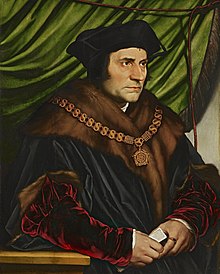
Sir Thomas More, one of the most famous early Lord Chancellors, served and was executed under Henry VIII.
A Man for All Seasons struggles with ideas of identity and conscience. More argues repeatedly that a person is divers by his conscience. His ain position is depicted as almost indefensible; the Pope is described as a "bad" and decadent individual, forced by the Emperor Charles V to act according to his will. Merely as More says to Norfolk, "What matters is non that information technology's truthful, merely that I believe it; or no, non that I believe it, but that I believe information technology." More than fears that if he breaks with his conscience, he will be damned to hell, while his associates and friends are more concerned with holding onto their own temporal ability.
At another key bespeak of the play, More testifies before an inquiry committee and Norfolk attempts to persuade him to sign the Succession to the Crown Act 1534 (pp. 78, Heinemann edition):
Norfolk:
- Oh, derange all this. ... I'g not a scholar, as Primary Cromwell never tires of pointing out, and frankly, I don't know whether the marriage was lawful or not. Merely damn it, Thomas, await at those names. ... You lot know those men! Tin't you lot do what I did, and come with usa, for fellowship?
More than:
- And when we stand before God, and you are sent to Paradise for doing co-ordinate to your conscience, and I am damned for non doing according to mine, will y'all come with me - for "fellowship"?
More's persecution is fabricated to seem even more unjust past the inclusion of Eustace Chapuys, the long-fourth dimension Imperial ambassador to England, in the story. Chapuys recognizes More as a stout man of the church, and in Act II, after More's resignation from the Chancellorship, he informs More of a planned rebellion along the Scottish border, expecting More to be sympathetic. Instead, More informs Norfolk of the plot, showing him to be patriotic and loyal to the Rex. This, along with More's refusal to speak out against the King, shows him to be a loyal field of study, and thus Cromwell appears to prosecute him out of personal spite and considering he disagrees with the Male monarch'south divorce.
Bolt besides establishes an anti-authoritarian theme which recurs throughout his works. All people in positions of power – King Henry, Cromwell, Wolsey, Cranmer, Chapuys, even Norfolk – are depicted as being either corrupt, evil, or at best expedient and power-hungry. Bolt's later plays and pic screenplays besides delve into this theme. The theme of corruption is as well illustrated, in Rich's rise to ability, the Common Man being drawn into the events of the storyline, and in the (deliberately) anachronistic portrayal of Henry every bit a younger, athletic man (in 1530 he would take been virtually 40 and already putting on weight).
Although it is the law that eventually forces More than'south execution, the play as well makes several powerful statements in support of the rule of law. At ane point More than'southward futurity son-in-law, Roper, urges him to arrest Richard Rich, whose perjury will eventually pb to More'south execution. More answers that Rich has broken no law, "And go he should if he were the Devil himself until he broke the law!" Roper is appalled at the thought of granting the Devil the benefit of law, but More is determined.
- "What would you do? Cut a nifty road through the police to become afterwards the Devil? ... And when the terminal law was down, and the Devil turned round on you – where would y'all hide, Roper, the laws all being flat? This country is planted thick with laws from coast to coast, Man's laws, not God'due south, and if y'all cutting them down – and you're simply the man to do it – exercise you lot actually think you lot could stand upright in the winds that would blow then? Yeah, I give the Devil benefit of police force, for my own safety's sake!"
The grapheme of the Common Man serves as a narrator and framing device. A Brechtian graphic symbol, he plays diverse small parts – More than'southward servant, a publican, a boatman, More than's jailer, jury foreman and executioner—who appear throughout the play, both taking role in and commenting on the activity. Several sequences involving this character break the 4th wall—most notably, a sequence where the Common Homo attempts to exit the stage and is addressed by Cromwell, who identifies him as a jury foreman. (Indeed, the "jury" consists of sticks or poles with the hats of the Common Human'due south various characters put on top.) The place of the Common Man in history is emphasized when he says in his opening speech,
- "the sixteenth century was the century of the Common Human being-similar all the other centuries."
Bolt created the Common Man for two main reasons: to illustrate the place and influence of the average person in history, even though they are commonly overlooked, and to try to forestall the audience from sympathising with the more titled characters such as More, realising that the audition is more closely related to him—a classic case of Brechtian alienation. The character's function in the story has been interpreted in many different ways by unlike critics, from existence a positive to a negative graphic symbol. Bolt'south ain view (expressed in the preface to the play) was that he was intended to describe the audience into the play and that "mutual" denoted "that which is common to us all."[three] Several of Bolt'south subsequent works feature similar characters (e.yard. The Disappointment of Businesswoman Bolligrew, State of Revolution).
Endings [edit]
Two different endings were written by Bolt. The original ending, performed during the evidence'due south preliminary run in England, had Cromwell and Chapuys face up each other subsequently More's execution and then exit the stage, hand in mitt, chuckling with "the self-mocking, self-indulgent, rather rueful laughter of the men who know what the globe is and how to be comfortable in it".
This particular ending is exemplary of Commodities's notion of "riding with the current", as is demonstrated past "men who know what the globe is and how to be comfortable in it", forsaking one's censor in exchange of a life of "convenience". For the testify's London production – and near, if not all, subsequent runs of the testify – the Common Human being sheds his executioner's garb and addresses the audience i final time:
- "... Information technology isn't difficult to continue alive, friends – just don't make trouble – or if you must make trouble, make the sort of trouble that's expected... If nosotros should bump into one another, recognize me."
The film version of the play ends with More's execution, followed past a narrator reading off the fates of the various characters involved (originally, this was dialogue spoken by the Common Man prior to the Tower of London Research).
Stage productions [edit]
Paul Scofield, who played the leading function in the Westward End premiere, reprised it on Broadway in 1961, winning a Tony Accolade. Both productions were directed by Noel Willman.
The original West Cease bandage, playing at the Globe Theatre (now Gielgud Theatre), included:
- The Common Man – Leo McKern
- Sir Thomas More – Paul Scofield
- Richard Rich – John Brown
- Knuckles of Norfolk – Alexander Judge
- Alice More than – Wynne Clark
- Margaret – Pat Keen
- Cardinal Wolsey – Willoughby Goddard
- Thomas Cromwell – Andrew Keir
- Chapuys – Geoffrey Dunn
- Attendant – Brian Harrison
- Will Roper – John Carson
- Henry Viii – Richard Leech
- Adult female – Beryl Andrews
- Archbishop Cranmer – William Roderick
In London, Man ran simultaneously to another of Commodities's plays, The Tiger and the Horse. Both plays were major hits, although Horse was the more successful of the ii. British critical reaction was largely positive, admitting reservedly so; few reviews at the time regarded the play every bit a classic. The prove ran for 320 performances.
In the The states, the play was starting time performed on Broadway on 22 Nov 1961, at the ANTA Playhouse
Original Broadway bandage
- The Common Man – George Rose
- Sir Thomas More – Paul Scofield
- The Knuckles of Norfolk – Albert Dekker
- Thomas Cromwell – Leo McKern (afterward Thomas Gomez)
- Rex Henry VIII – Keith Baxter
- Margaret More than – Olga Bellin
- William Roper – Peter Brandon
- Catherine Acrimony – Sarah Burton
- Attendant – John Colenback
- Cardinal Wolsey – Jack Creley
- Alice More- Ballad Goodner
- Thomas Cranmer – Lester Rawlins
- Richard Rich – William Redfield
- Signor Chapuys – David J. Stewart
The Broadway production was a huge hit, running for 620 performances. While the play had drawn mixed critical reviews in London, it was almost unanimously praised by the New York critics, who showered it with plaudits and awards. At the 16th Annual Tony Awards, the product earned four nominations, winning in all four categories it was nominated, including Tonys for Bolt, Scofield, and Willman.[iv]
Leo McKern played the Common Human being in the West End version of the show, only was shifted to the office of Cromwell for the Broadway production – a role he later reprised in the film. While playing Cromwell, he appeared with ane brown and one blue eye (McKern of course had lost an middle in an accident and wore a drinking glass one) to accentuate his graphic symbol'due south evil nature.
Charlton Heston played More than in several versions of the play-off-Broadway in the 1970s and 1980s, eventually playing information technology in the West End. The play was a success and the West Cease production was taken to Aberdeen, Scotland, for a week where it was staged at His Majesty's Theatre. Heston considered it among his favourite roles. He also produced, directed, and starred in a flick version of it (come across beneath). The production gained a sort of notoriety when Dustin Hoffman spread the story that Heston, who was bald, was then vain that he wore a wig over his hairpiece, rather than let the public view his actual bald pate.
Another famous graduate of the play is Ian McKellen, whose first theatrical part was as Will Roper in a revival production in the belatedly 1960s. He would keep to play More in a subsequently run of the show. Faye Dunaway also made her stage debut as a replacement Margaret in the original Broadway run.
An acclaimed Canadian production starring William Hutt and directed by Walter Learning was presented at the Vancouver Playhouse and the Stratford Festival in 1986. At Stratford the product was paired with a product of Shakespeare'south Henry VIII, with both plays sharing many actors, and showing two perspectives on historical events.
The play was staged in London's West Terminate at the Theatre Royal, Haymarket starring Martin Shaw and produced by Nib Kenwright. Information technology airtight on 1 April 2006.
A Broadway revival of the show, produced past the Roundabout Theatre Visitor, starring Frank Langella as More and directed by Doug Hughes, played at the American Airlines Theatre through December 2008. In this product, the character of The Common Man was deleted by the director (as Commodities had done when adapting his play for the start film version).[5]
In 2008, Thomas More was likewise portrayed on stage in Hong Kong as an allegorical symbol of the Pan-democracy camp resisting Chinese Communism when Hardy Tsoi, after translating A Man for All Seasons, mainly into Cantonese, but also with some parts in Mandarin, Spanish, Latin, and English language, produced it every bit a play within a play.[6] Similarities were noted betwixt More and contemporary pro-democracy politicians in Hong Kong such as Martin Lee and Szeto Wah, with the Vatican being seen as representing British colonialism while Henry VIII and his government were seen as representing Communist People's republic of china "suppressing republic and freedom" in Hong Kong.[vi] Co-ordinate to Chapman Chen, Hardy Tsoi's version of the play is one of a number of Hong Kong works that propose that mainstream postcolonial theories which invariably portray European colonialism equally oppressive need to be "modified or balanced" to reverberate the different experience of places similar Hong Kong.[6]
Moving-picture show and goggle box movies [edit]
The play was adapted for Australian goggle box in 1964.
1966 film [edit]
Paul Scofield, who played the leading role in the W End and Broadway stage premieres, played More over again in the get-go of ii film versions (1966), winning an Oscar in the procedure. The film also stars Robert Shaw every bit Henry VIII, Orson Welles as Wolsey, Corin Redgrave as Volition Roper, Nigel Davenport equally Norfolk, a young John Hurt as Richard Rich, and an older Wendy Hiller as Lady Alice, More'due south second wife. It was directed by Fred Zinnemann. In improver to the Best Actor Oscar won by Scofield, the film won Academy Awards for screenplay, cinematography, costume pattern, Best Director, and Best Picture.
1988 film [edit]
The 1988 version starred Charlton Heston (who also directed information technology) as More, Vanessa Redgrave (who appeared briefly and mutely in the 1966 version as Anne Boleyn) as More's married woman, and Sir John Gielgud as Central Wolsey. Past coincidence, Gielgud'southward name now graces the one-time Globe Theatre, where the original play premiered in 1960.
Radio productions [edit]
The play was produced, with the following bandage, as the Saturday Night Theatre on BBC Domicile Service on 28 February 1959:
- Sir Thomas More — John Franklyn-Robbins
- Primary Richard Rich — Michael Cox
- Master Thomas Cromwell — David Mahlowe
- Central Wolsey — Ralph Hallett
- King Henry 8 — David Scase
- Knuckles of Norfolk — David Sumner
- Dame Alice More than — Cynthia Grenville
- Mistress Margaret (Million) More than — Marah Stohl
- Archbishop Thomas Cranmer — Stephen MacDonald
- The Bishop of Bath — Christopher Benjamin
- The Bishop of Durham — Bernard Kay
The play was produced, with the following cast, as the Saturday Play on BBC Radio 4 on 7 October 2006, as function of its Betrayal season:
- Sir Thomas More — Charles Dance
- Master Richard Rich — Julian Rhind Tutt
- Master Thomas Cromwell — Kenneth Cranham
- Primal Wolsey — Timothy Bateson
- King Henry VIII — Brian Cox
- Knuckles of Norfolk — Nicholas le Prevost
- Main William Roper — Martin Freeman
- Alice More — Kika Markham
- Mistress Margaret (Meg) More — Romola Garai
- Boatman/Steward (aka Matthew) /Jailer — Dan Chyutin
- Archbishop Thomas Cranmer/Headsman — Peter Tate
- Catherine of Aragon — Adjoa Andoh
See too [edit]
- Trial movies
- Cultural depictions of Henry 8 of England
References [edit]
- ^ "A Man for All Seasons Listing" InternetMovieDatabase, accessed 23 Baronial 2011
- ^ "A Human being for all Seasons: an Historian'due south Demur". Catholiceducation.org. four December 1977. Retrieved 28 December 2016.
- ^ Commodities, Robert (1963) [1960]. Forest, E.R. (ed.). A Man for All seasons (The Hereford Plays ed.). London: Heinemann. pp. xviii.
- ^ "Winners / 1962". www.tonyawards.com . Retrieved 16 November 2020.
- ^ Cox, Gordon (21 May 2008). "Frank Langella to exist 'Man' on B'way – Entertainment News, Legit News, Media – Variety". Diverseness.com. Retrieved 23 August 2011.
- ^ a b c Chen, Chapman (2011). "Postcolonial Hong Kong Drama Translation". In Pekka Kujamäki (ed.). Beyond Borders: Translations Moving Languages, Literatures and Cultures. Berlin: Frank & Timme GmbH. pp. 47–54. ISBN9783865963567.
External links [edit]
- A Man for All Seasons at the Internet Broadway Database
- A Man for All Seasons at the Internet Broadway Database
- Free Written report Guide for "A Homo for All Seasons" at TheBestNotes.com
- Complete text of the play at cooper.edu (Archived link March 2007)
- Consummate text of the play at veng6a.pbworks.com
Source: https://en.wikipedia.org/wiki/A_Man_for_All_Seasons
Posted by: windomdediatesons.blogspot.com
0 Response to "A Man For All Seasons Film"
Post a Comment